

Turning customer noise into revenue-backed product decisions

Univrs.ai

2025-2026

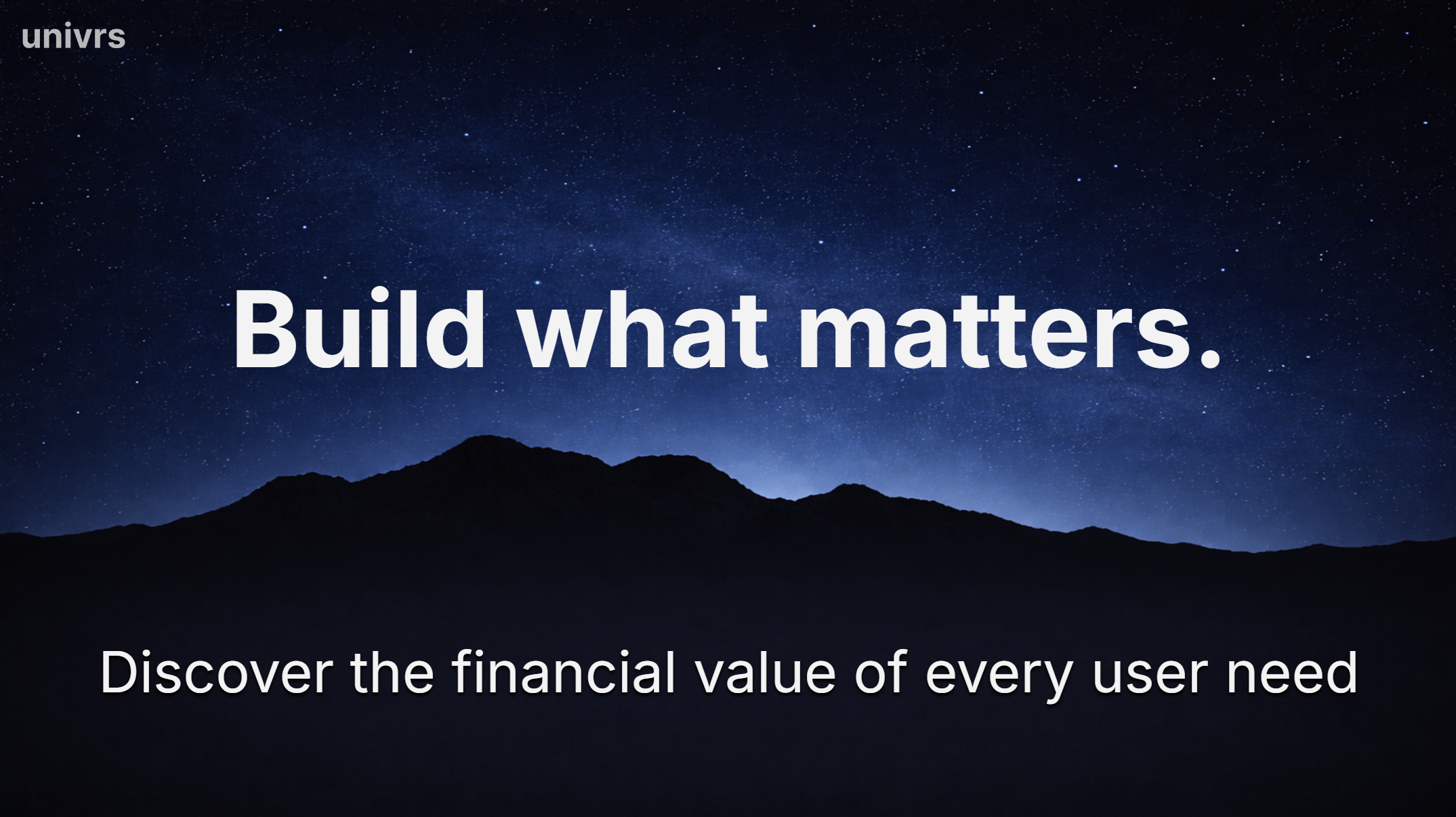
Powerpoint header slider with text "univrs", "Build what matters.", and "Deiscover the financial value of every user need"

Don’t just listen to the loudest customer - listen to the loudest signal.

Snapshot

Role

Founder / Product Lead / UX Lead / AI Developer

Problem we solved

Lack of clarity regarding what to prioritize in product roadmap due to noise and lack of hard data

Outcome

Extremely sophisticated AI-powered data analytics synthesis platform.


Ingest mass survey, interview, sales call, support ticket, and Voice of Customer data, alongside predictive metrics and account data and producing business valuations for every single user need across hundreds of thousands of data points.

Problem Space

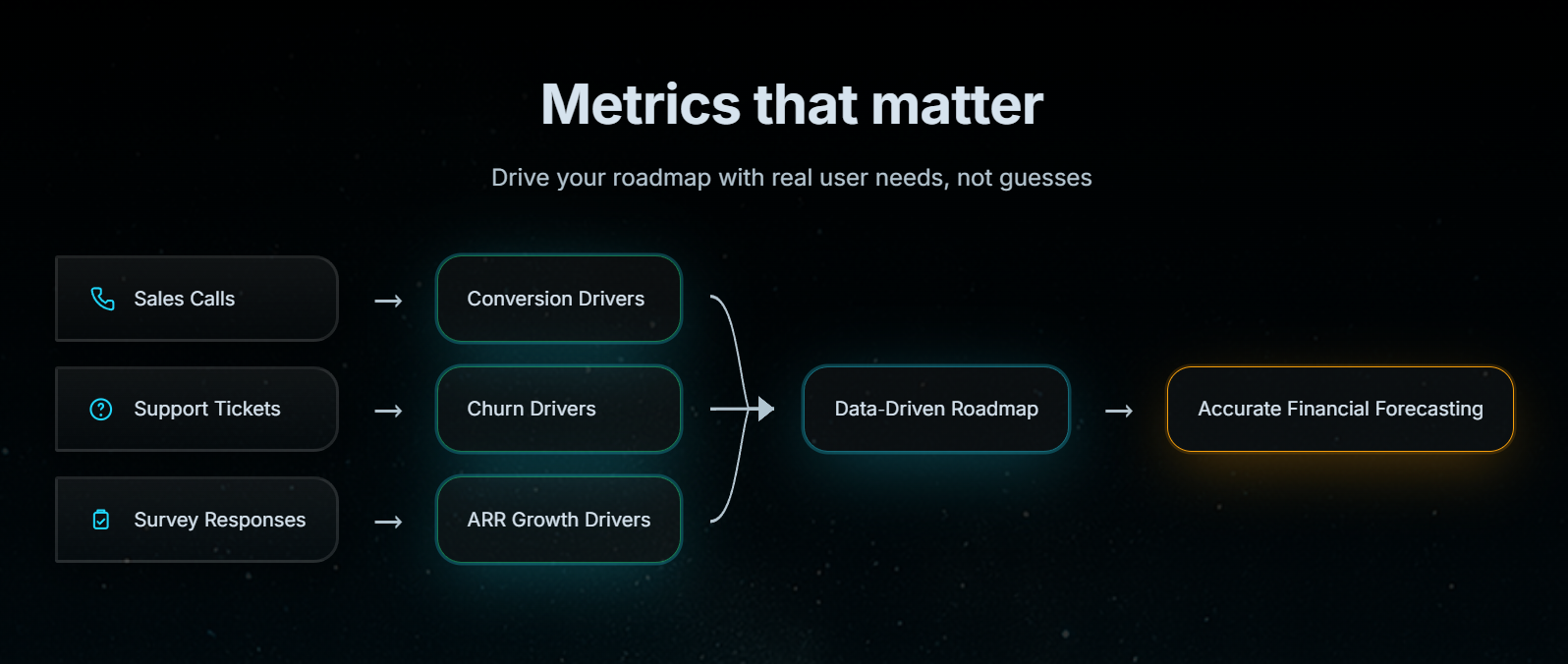
Product teams operate across fragmented inputs:

  • Support tickets
  • Sales conversations
  • CSM feedback
  • User interviews
  • Surveys
  • Voice of Customer
  • Analytics Data
  • Account data

Teams struggled to answer:

  • What problems matter most?
  • What is the financial impact of each user need or request?
  • What should we build now vs later?
  • What is the estimated ROI of our roadmap, and how confident are we in that?

The challenge is often not in collecting data but rather in extracting the value from it in a way that’s useful for product strategy and prioritization.

My Role

I led the team from concept to launch, doing the majority of business development, strategy, design, research, AI development, and a substantial amount of the feature development.

Defined product vision and core technology

Developed AI + Deterministic hybrid workflows

Created UX architecture

Developed methods for multi-modality synthesis

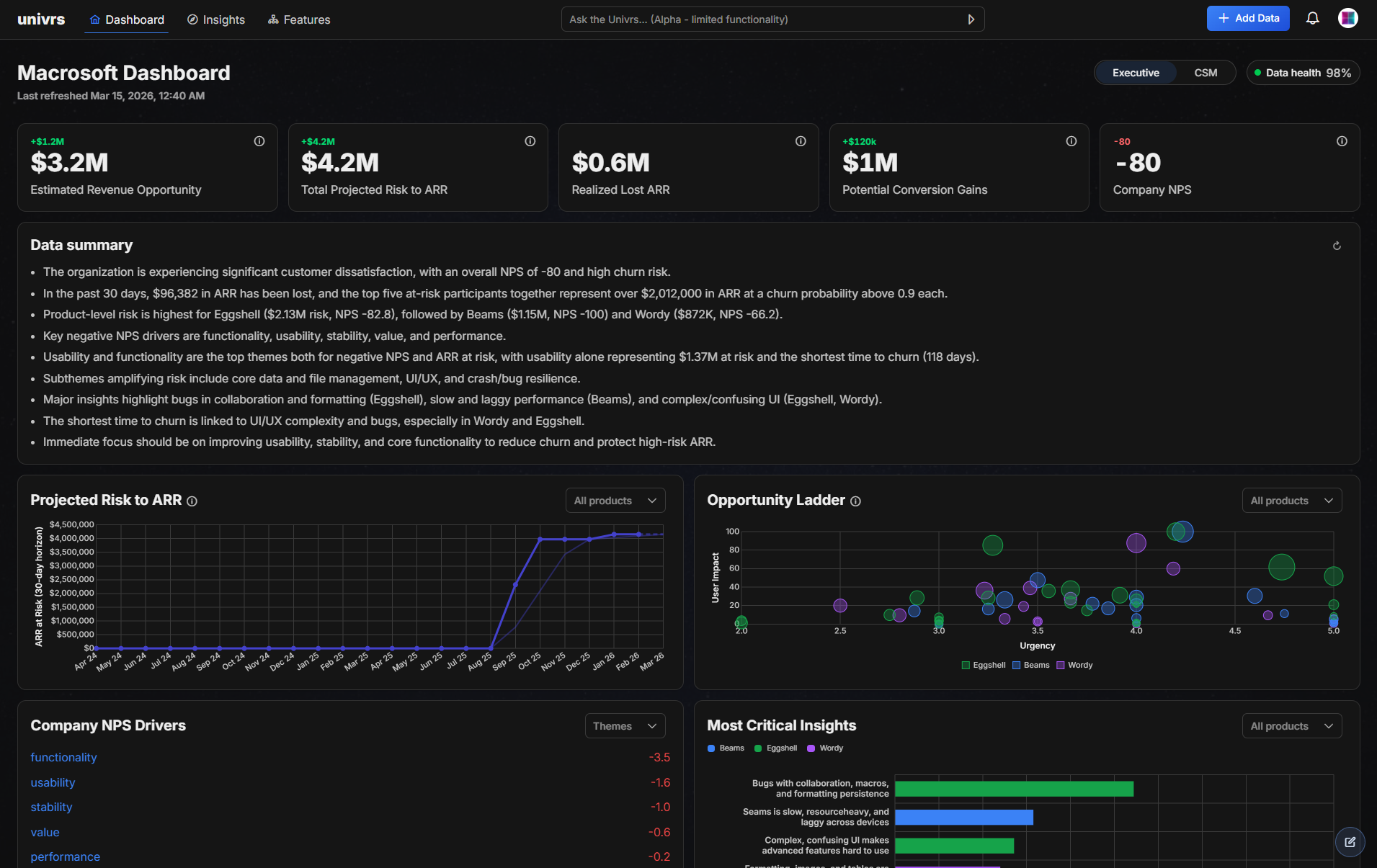
System Design: From Data to Decision

Step 1

Ingest

  • Multi-source data
  • Structures + unstructured pipelines
  • CSV, APIs, Integrations

Step 2

Understand (AI Layer)

  • Natural language fractioning
  • Theming and tagging
  • Insight aggregation
  • Pattern recognition and synthesis
  • Solution generation

Step 3

Quantify (Deterministic Layer)

  • Revenue and Impact Modeling
  • Churn and risk calculations
  • Priority scoring and analysis

Step 4

Decide

  • Feature generation and requirement writing
  • Executive dashboards
  • CSM dashboards
  • Comparative analysis
  • AI-assisted roadmap generation

AI System Design

I defined clear boundaries between AI and deterministic systems.

AI Handles:

  • Language understanding
  • Clustering and summarization
  • Solutions and Requirements generation
  • Feature generation
  • Roadmap generation

Deterministic System Handles:

  • Financial calculations
  • Risk modeling
  • Final prioritization outputs
  • Chart and Graph generation

Outcome

Univrs.ai enables an end-to-end workflow from raw feedback to prioritized roadmap decisions.


It reduces ambiguity in prioritization through quantified impact modeling, replaces fragmented tools with a unified decision system, and accelerates insight synthesis and requirement drafting.

Logomark

Anthony Fransella

Turning customer noise into revenue-backed product decisions

Univrs.ai

2025-2026
Powerpoint header slider with text "univrs", "Build what matters.", and "Deiscover the financial value of every user need"

Don’t just listen to the loudest customer - listen to the loudest signal.

Snapshot

Role

Founder / Product Lead / UX Lead / AI Developer

Problem we solved

Lack of clarity regarding what to prioritize in product roadmap due to noise and lack of hard data

Outcome

Extremely sophisticated AI-powered data analytics synthesis platform.


Ingest mass survey, interview, sales call, support ticket, and Voice of Customer data, alongside predictive metrics and account data and producing business valuations for every single user need across hundreds of thousands of data points.

Problem Space

Product teams operate across fragmented inputs:

  • Support tickets
  • Sales conversations
  • CSM feedback
  • User interviews
  • Surveys
  • Voice of Customer
  • Analytics Data
  • Account data

Teams struggled to answer:

  • What problems matter most?
  • What is the financial impact of each user need or request?
  • What should we build now vs later?
  • What is the estimated ROI of our roadmap, and how confident are we in that?

The challenge is often not in collecting data but rather in extracting the value from it in a way that’s useful for product strategy and prioritization.
My Role

I led the team from concept to launch, doing the majority of business development, strategy, design, research, AI development, and a substantial amount of the feature development.

Defined product vision and core technology

Developed AI + Deterministic hybrid workflows

Created UX architecture

Developed methods for multi-modality synthesis
System Design: From Data to Decision

Step 1

Ingest

  • Multi-source data
  • Structures + unstructured pipelines
  • CSV, APIs, Integrations

Step 2

Understand (AI Layer)

  • Natural language fractioning
  • Theming and tagging
  • Insight aggregation
  • Pattern recognition and synthesis
  • Solution generation

Step 3

Quantify (Deterministic Layer)

  • Revenue and Impact Modeling
  • Churn and risk calculations
  • Priority scoring and analysis

Step 4

Decide

  • Feature generation and requirement writing
  • Executive dashboards
  • CSM dashboards
  • Comparative analysis
  • AI-assisted roadmap generation

AI System Design

I defined clear boundaries between AI and deterministic systems.

AI Handles:

  • Language understanding
  • Clustering and summarization
  • Solutions and Requirements generation
  • Feature generation
  • Roadmap generation

Deterministic System Handles:

  • Financial calculations
  • Risk modeling
  • Final prioritization outputs
  • Chart and Graph generation

Outcome

Univrs.ai enables an end-to-end workflow from raw feedback to prioritized roadmap decisions.


It reduces ambiguity in prioritization through quantified impact modeling, replaces fragmented tools with a unified decision system, and accelerates insight synthesis and requirement drafting.
Logomark

Anthony Fransella

Turning customer noise into revenue-backed product decisions

Univrs.ai

2025-2026

Powerpoint header slider with text "univrs", "Build what matters.", and "Deiscover the financial value of every user need"

Don’t just listen to the loudest customer - listen to the loudest signal.

Snapshot

Role

Founder / Product Lead / UX Lead / AI Developer

Problem we solved

Lack of clarity regarding what to prioritize in product roadmap due to noise and lack of hard data

Outcome

Extremely sophisticated AI-powered data analytics synthesis platform.


Ingest mass survey, interview, sales call, support ticket, and Voice of Customer data, alongside predictive metrics and account data and producing business valuations for every single user need across hundreds of thousands of data points.

Problem Space

Product teams operate across fragmented inputs:

  • Support tickets
  • Sales conversations
  • CSM feedback
  • User interviews
  • Surveys
  • Voice of Customer
  • Analytics Data
  • Account data

Teams struggled to answer:

  • What problems matter most?
  • What is the financial impact of each user need or request?
  • What should we build now vs later?
  • What is the estimated ROI of our roadmap, and how confident are we in that?

The challenge is often not in collecting data but rather in extracting the value from it in a way that’s useful for product strategy and prioritization.

My Role

I led the team from concept to launch, doing the majority of business development, strategy, design, research, AI development, and a substantial amount of the feature development.

Defined product vision and core technology

Developed AI + Deterministic hybrid workflows

Created UX architecture

Developed methods for multi-modality synthesis

System Design: From Data to Decision

Step 1

Ingest

  • Multi-source data
  • Structures + unstructured pipelines
  • CSV, APIs, Integrations

Step 2

Understand (AI Layer)

  • Natural language fractioning
  • Theming and tagging
  • Insight aggregation
  • Pattern recognition and synthesis
  • Solution generation

Step 3

Quantify (Deterministic Layer)

  • Revenue and Impact Modeling
  • Churn and risk calculations
  • Priority scoring and analysis

Step 4

Decide

  • Feature generation and requirement writing
  • Executive dashboards
  • CSM dashboards
  • Comparative analysis
  • AI-assisted roadmap generation

AI System Design

I defined clear boundaries between AI and deterministic systems.

AI Handles:

  • Language understanding
  • Clustering and summarization
  • Solutions and Requirements generation
  • Feature generation
  • Roadmap generation

Deterministic System Handles:

  • Financial calculations
  • Risk modeling
  • Final prioritization outputs
  • Chart and Graph generation

Outcome

Univrs.ai enables an end-to-end workflow from raw feedback to prioritized roadmap decisions.


It reduces ambiguity in prioritization through quantified impact modeling, replaces fragmented tools with a unified decision system, and accelerates insight synthesis and requirement drafting.